
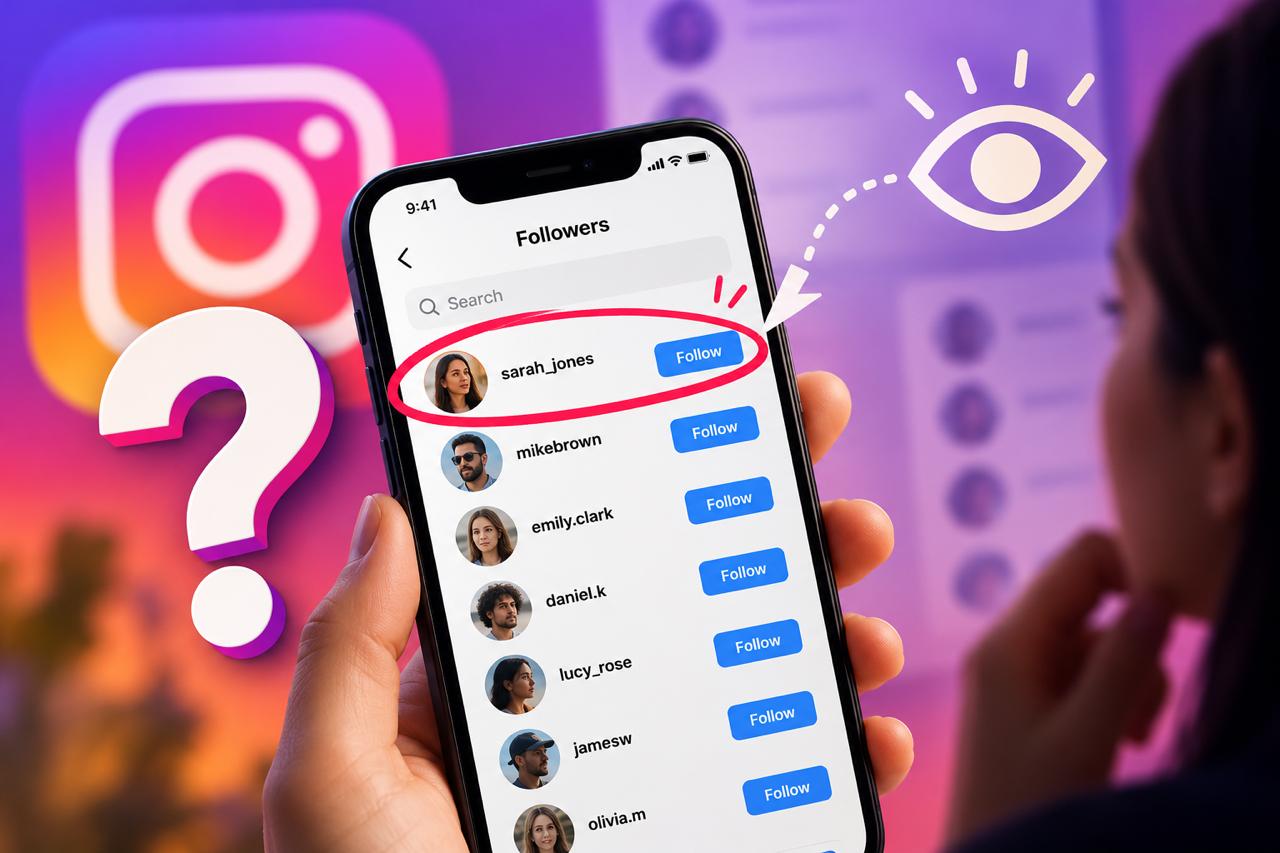
A few times a month, someone sends us a screenshot of a followers list with one name circled at the top. The message underneath is almost always some version of the same question: "Why is she always first? Does that mean she's checking my profile?"
I understand why people ask. A list looks like a ranking, and a ranking looks like it should mean something. But after looking at this from every angle I could find, including Instagram's own documentation and my own accounts, my honest answer is that the order of a followers or following list tells you very little about the other person and a lot about you.
Here is what I've actually seen, what Instagram has said, and, just as important, what it has never said.
The short answer
The lists are not a timeline. Someone else's followers or following list isn't shown in the order people followed, so you can't read "who they followed most recently" from it.
The order is personal to the person looking. Two people opening the same list can see it in a different order.
The top of the list is not a visitor log. Instagram doesn't show who viewed your profile, and the list order isn't a hidden way of doing it.
The only place you'll find real follow dates is your own data. And it's only your own account, never someone else's.
Why this question keeps landing in my inbox
Running an Instagram growth service means I hear the same worries over and over. The biggest one is whether anyone can see who viewed your Instagram profile (they can't). The list-order question is its close cousin. When people can't get a visitor list, they start looking for clues somewhere else, and the followers list is the most obvious place.
The pattern is almost always the same. One person keeps appearing near the top, and the conclusion is that they must be watching. What makes this belief so sticky is that it's partly true, just not in the direction people think. That person often is near the top for a reason. The reason is usually the relationship between your two accounts, not something they did secretly last night.
What Instagram has said, and what it hasn't
Before writing this, I went through Instagram's Help Center looking for an article that explains how followers and following lists are ordered. I couldn't find one. There are pages on removing a follower, on how many accounts you can follow (the cap is 7,500), and on blocking, but nothing that describes the order itself.
That matters, because it means every "this is exactly how the list works" article you read, including the confident ones, is a guess. So is mine. The difference I'd like to make is to be clear about which parts are documented and which are observations.
What Instagram has documented is how it thinks about relationships between accounts in general. In its explanation of how ranking works, Instagram says it doesn't have one single algorithm, and that one of the signals it uses is your history of interacting with someone, such as whether you comment on each other's posts. If you want the wider picture, I've written separately about how Instagram ranking works across Feed, Reels, Stories and Explore.
Meta's Transparency Center goes further for one people-focused surface: Suggested Accounts. The signals it lists include how many mutual friends you have with an account, whether that account follows you, and how long it has been following you. To be clear, that page is about suggestions, not your followers list, and I'm not claiming the list uses the same model. What it shows is the kind of information Instagram uses when it puts people in front of you: mutual connections, follow relationships and closeness. Not profile visits.
Your lists vs someone else's lists
Most of the confusion comes from treating every list as the same thing. They aren't. Here's how I break it down:
List | Who it's ordered for | What the order can tell you | What it can't tell you |
|---|---|---|---|
Your own followers | You | Roughly which followers you're most connected to | Who visited your profile, or when |
Your own following | You | On my account, the date you followed each person, if you switch the sort | How much those accounts look at you |
Someone else's followers | You, the viewer | Which of their followers you already know or interact with | Who they're close to, or who follows them most recently |
Someone else's following | You, the viewer | Overlap between their circle and yours | Who they followed last, or who they care about most |
That last column is the important one. When you open someone else's list, Instagram is arranging it for you. So the people near the top tend to be people you already have something to do with: accounts you follow, mutuals, people you message. That's a reflection of your own network, not a confession from theirs.
The test that changed how I explain this
The simplest way I've found to show this is to open the same public account's following list from two different Instagram accounts. I did this with my personal account and a work account that follows a completely different set of people.
The two lists started differently. On my personal account, the first names were mostly people I follow. On the work account, they were mostly accounts in our niche. Same list, same moment, two different "tops".
If the order were a record of what the account owner did, both accounts would have seen the same first rows. They didn't. You can repeat this in two minutes with a friend: both of you open the same public list and compare the first ten names.
"The person at the top is stalking me"
Let me take the most common version head-on, because it's the one that actually upsets people.
If someone is near the top of your own followers list, the most likely reasons are boring ones: you interact with them, you have mutual friends, you message each other, or you've looked at their content. All of that is your activity just as much as theirs. Instagram doesn't publish a feature that ranks people by how often they view your profile, and I've never seen anything in the app that behaves like one.
I've also tested the apps that promise to reveal "profile stalkers". One of them wanted my Instagram login before it would show anything. Two others showed me different "top visitors" for the same account. If a hidden visitor ranking really existed, they couldn't both be right. My advice is simple: never give your password to an app like that. If you already have, change it and turn on two-factor authentication.
Is the following list in chronological order?
Not when you're looking at someone else's. You'll sometimes see a newer follow close to the top, which is probably where the "it's chronological" belief comes from. But it's not reliable enough to draw conclusions from, and the rest of the list clearly isn't in date order.
Your own following list is different. On my account there's a sort control on that screen, and switching it from the default to the date I followed people does put them in order. It only works on my own list, not on anyone else's. Because Instagram doesn't document this in the Help Center, I wouldn't assume every account or app version shows it the same way.
Can you see who someone recently followed?
Not from inside Instagram. There used to be a "Following" activity tab that showed what people you follow were liking and following, and Instagram removed it back in 2019. Nothing has replaced it.
That gap is exactly what "recent follows tracker" apps sell into. Some of them simply re-check a public list over time and compare the snapshots. Others ask for your login. Either way, they're not part of Instagram, and the list order they rely on isn't a timeline to begin with. The privacy point also cuts both ways: if this kind of tracking bothers you when it's aimed at you, it's worth asking whether you want to do it to someone else.
Where the real dates actually are
If what you really want is when someone followed you, or when you followed someone, the honest place to look is your own data.
Instagram lets you export a copy of your information from your account settings. Depending on which version you have, the route is Settings → Meta Account (or Accounts Center) → Your information and permissions → Export your information → Create export. From there you can pick the information you want, a date range and a format.
When I exported my own followers and following, the files listed each account with a date. That's the closest thing to a real timeline Instagram gives you. Two practical notes from Instagram's own page: the export can take time to prepare (Instagram says up to 30 days for the email link), and once it's ready you have 4 days to download it. It only covers your account. There's no official way to get anyone else's.
What actually changes who appears in your lists
The order is out of your hands, but who is in your lists isn't. These are the controls Instagram documents:
Remove a follower. If your account is private, you can remove someone from your followers list. Instagram says they aren't notified.
Review flagged followers. On public accounts, Instagram may flag followers it thinks are spam, bots or irrelevant, and you can review and remove flagged followers in one go. Instagram notes this feature may not be available to everyone yet.
Block. Blocking also stops someone from following you, and people aren't notified when you block them.
Automatic clean-ups. Instagram routinely removes disabled accounts and inauthentic activity, so your follower and following totals can change even when you did nothing.
If you want to check an account's exact follower count instead of the rounded number on the profile, that's a separate question from the list order, and a much easier one to answer.
Who can see your lists in the first place
This is the part I wish more people knew, because it's documented and it's often misunderstood. According to Instagram's comparison of public and private accounts:
If your account is public, anyone on Instagram can see who you follow and who follows you.
If your account is private, only your followers can see the private accounts you follow and the private accounts that follow you.
Even with a private account, the public accounts you follow, and the public accounts that follow you, are visible to anyone on Instagram and Threads. The easiest way to picture it is that you still appear in a public account's own followers list, and anyone can open that.
Accounts for people under 18 are private by default.
So "I'm private, nobody can see who I follow" is only half true. If you follow a public account, your name sits in its followers list where anyone can see it.
What I'd read into the order instead
If you want to use your lists for something real, don't read them like a mystery to be solved. Read them like a mirror. The names near the top are mostly the people you engage with. If those aren't the people you actually care about, that tells you something about how you use the app.
For creators and businesses, the more useful signal is never the order of names. It's whether the right people are following and staying. That's what I'd look at in your follower growth in Insights: who follows after which posts, and who leaves. If you're building an account and want a stronger starting base, that's also where something like gradual follower growth fits. It changes the size of your audience. It doesn't change, and can't tell you anything about, the order of anyone's list.
What I'd tell a friend
If a friend sent me that circled screenshot, I'd tell them this: the person at the top of your list is there mostly because of the connection between your accounts, not because they've been checking on you. Someone else's list is arranged for you, not by them. And if you really need dates, export your own data, because that's the only real timeline Instagram gives you.
It's a less exciting answer than "she's obviously stalking you". But it's the one that holds up when you actually test it.